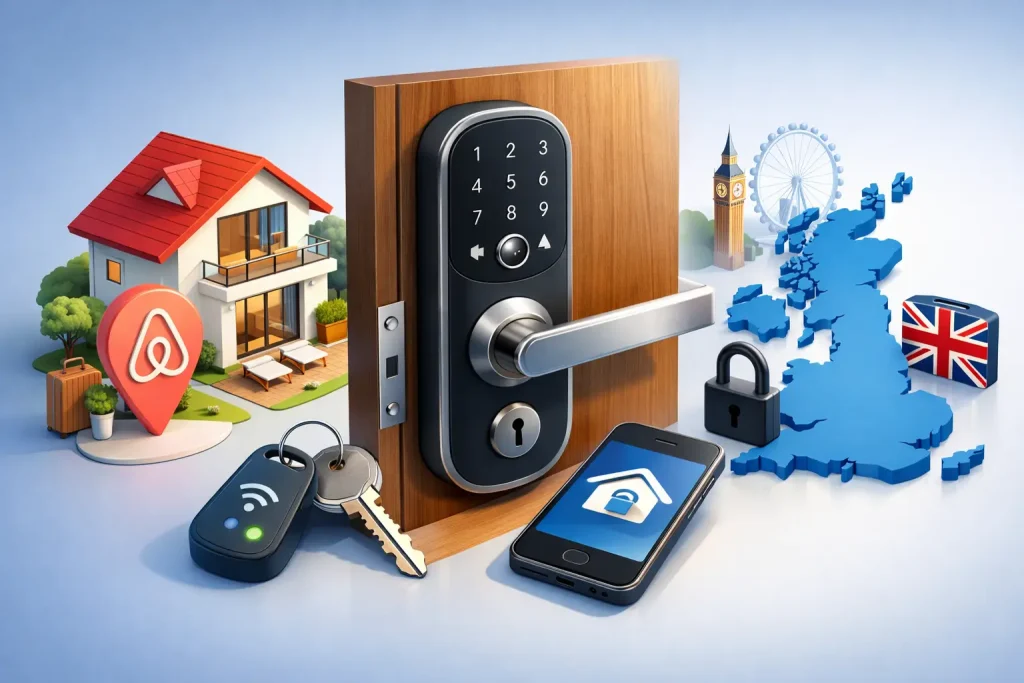
A guest arrives after a delayed flight, it is raining, and they cannot get into the property. That is usually when hosts start asking about Airbnb lock requirements UK and whether their current setup is actually suitable. The short answer is that there is no single Airbnb-specific lock law in the UK, but there are clear expectations around safety, secure access, emergency escape, insurance and, in some cases, local licensing rules.
If you run a short-let, the lock on the door is not just a convenience item. It affects guest safety, property security, cleaning handovers, late check-ins and what happens if something goes wrong. A good setup should let authorised guests in easily, keep everyone else out, and still allow a quick exit from inside without needing a key. Scotia Locksmiths is happy to provide free advise on AirBnB and short-term let requirements.
https://scotia-locksmiths.com/airbnb-hmo-guidance/
What Airbnb lock requirements UK usually mean in practice
Most hosts use the phrase Airbnb lock requirements UK when they are really asking four different questions. Is the property secure enough for paying guests? Can guests enter without delays or confusion? Can they get out safely in an emergency? And will the lock arrangement cause problems with insurance, licensing or managing agents?
That is why there is no one-size-fits-all answer. A city-centre flat in a managed block has different constraints from a detached holiday cottage or an HMO-style property used for short stays. The right lock depends on the door type, how the building is occupied and what other access controls are already in place.
As a starting point, your entrance door should have a properly fitted, good-quality locking system in sound working order. It should not stick, need force, or rely on a guest knowing a trick to make it work. If there is any doubt, deal with that before the next booking rather than after a bad review.
Security matters, but so does emergency escape
This is where many hosts get caught out. They focus on stopping unauthorised entry but forget that guests may never have used that lock before. In a fire or other emergency, they should be able to leave quickly and intuitively.
For many short-let properties, the safest approach is a lock that secures the door from outside but allows immediate exit from inside without searching for a key. On some doors, that means
a thumbturn cylinder or an internal turn knob. On others, especially multipoint uPVC or composite doors, the arrangement needs more thought because the handle operation and locking method can vary.
That does not mean every thumbturn is automatically right. If there is glazed panelling near the lock, or if a hand could reach in through broken glass, a standard thumbturn may reduce security unless the wider door and glazing setup is suitable. Like most lock decisions, it depends on the whole door, not just one part.
Smart locks are common, but they are not a free pass
A lot of short-let hosts prefer smart locks or keypad entry because they remove the need to meet guests or leave keys in insecure places. That can work well, especially for late arrivals and back-to-back changeovers. It also makes code changes easier when guests leave.
But smart access only works if the hardware is reliable and fitted properly. A poorly installed smart lock on a weak or badly aligned door is still a weak door. Battery-powered devices also need a plan for failure. Guests need clear instructions, backup entry arrangements and a support contact if the code does not work.
There is also a practical point many hosts overlook. Some smart lock products suit internal doors better than external front doors in UK properties. Others may not integrate well with multipoint locking systems common on uPVC and composite doors. Before fitting anything, make sure it is designed for your exact door type and will not compromise fire escape from inside.
Key safes can be useful, but placement matters
Key safes are still widely used across the UK, particularly where a full smart lock is not appropriate. They are simple, affordable and familiar to guests. For many hosts, they strike a sensible balance between convenience and cost.
The weakness is usually not the safe itself but how it is used. If it is fitted in an obvious place, the code is never changed, or the key label identifies the property, you are making life easier for the wrong people as well as your guests. A police-approved style key safe in a discreet but accessible location is generally a better option than the cheapest box online screwed into soft mortar.
If you use a key safe, keep the instructions short and accurate. Guests arriving in the dark with luggage do not want a puzzle.
Insurance and lease rules can matter as much as the lock
Some hosts assume that if the lock works, that is the end of it. Often it is not. Your insurer may expect certain door and window
security standards, especially if the property is left empty between bookings or used as a holiday let. If your policy refers to specific lock standards and your door does not meet them, that can become a problem at claim stage.
Flats and managed developments can add another layer. Your title conditions, building rules or managing agent may restrict changes to communal entrances, door furniture or external appearance. In listed buildings and some conservation settings, appearance may matter too. So before replacing hardware, check what you are allowed to change.
This is one reason a
proper inspection is worth having. It is far better to identify a conflict before buying new hardware than to pay twice.
The lock should suit the door, not the other way round
A common mistake in short-let properties is choosing access method first and trying to force it onto the existing door. In reality, the door condition often decides what will work.
Timber doors, aluminium doors, uPVC doors and composite doors all behave differently. Older timber doors may need upgraded
night latches, mortice locks or closer adjustment. uPVC and composite doors often suffer from misalignment, worn gearboxes or stiff mechanisms, which guests experience as a faulty lock even when the root issue is the door setup itself.
If guests need to lift the handle hard, pull the door towards them, or jiggle the key, that is not a minor annoyance. It is a failed access experience waiting to happen. In many cases, realigning the door or replacing worn lock components solves the problem without replacing the whole door.
When local licensing or HMO rules may apply
For standard short-lets, there is no single national rulebook labelled for Airbnb locks alone. But depending on where the property is and how it is operated, licensing and safety requirements can affect what is expected. In Scotland especially, short-term let licensing has changed how many hosts need to think about safety and compliance.
Where a property falls under HMO rules, mixed-use arrangements or stricter local authority standards, internal doors, escape routes and locking arrangements may need a more careful review. What is acceptable in a single self-contained holiday cottage may not be suitable in a larger shared property.
If you are unsure, it is better to ask before a visit from the council, insurer or fire assessor forces the issue. The cost of getting it right early is usually lower than sorting out a failed inspection or a security incident later.
What hosts should check before the next booking
If you want a practical standard to work from, focus on this. Guests should be able to enter without delay, lock the property securely behind them, and leave from inside quickly without needing specialist knowledge. The hardware should be in good condition, suited to the door, and backed by a sensible backup plan if codes, keys or batteries fail.
You should also check whether your insurer expects a particular lock standard, whether your building rules restrict changes, and whether your local licensing conditions say anything relevant about guest safety or escape. These are not small print issues. They are part of running a short-let properly.
For hosts in central Scotland, this is often where a local locksmith adds real value. Not by selling the most expensive option, but by checking the door, explaining what is practical, and making sure the setup works in day-to-day use. Scotia Locksmiths sees this regularly with holiday lets where the real issue is not the brand of lock but poor alignment, tired hardware or an entry method that looked fine on paper and failed in real use.
A sensible approach for most UK short-lets
The best lock setup is usually the one guests barely notice. It works first time, feels secure, and does not create confusion at the door. Sometimes that is a smart lock. Sometimes it is a well-fitted mechanical lock with a key safe. Sometimes it is simply repairing a sticking multipoint lock and changing the cylinder to something more suitable.
If your current arrangement leaves guests calling after midnight, struggling with a stiff handle or wondering how to get out in an emergency, it needs attention. Short-let security does not have to be complicated, but it does need to be thought through properly before the next arrival, not after.
Scotia Locksmiths are trusted, local, mobile locksmiths serving the following areas:
Perthshire & Kinross: Perth,
Crieff,
Blairgowrie,
Kinross,
Pitlochry,
Aberfeldy
Stirlingshire: Stirling,
Dunblane,
Callander,
Killin,
Lochearnhead
Dundee & Angus: Dundee,
Broughty Ferry,
Monifieth,
Carnoustie
Fife: Dunfermline,
Kirkcaldy,
Glenrothes,
St Andrews,
Cupar,
Leven,
Rosyth
West Lothian and Falkirk: Falkirk,
Grangemouth,
Livingston,
Bathgate
Lanarkshire: Cumbernauld,
Airdrie,
Bellshill,
Motherwell,
Hamilton,
Cambuslang
Clackmannanshire: Alloa,
Tillicoultry,
Tullibody,
Alva,
Dollar.