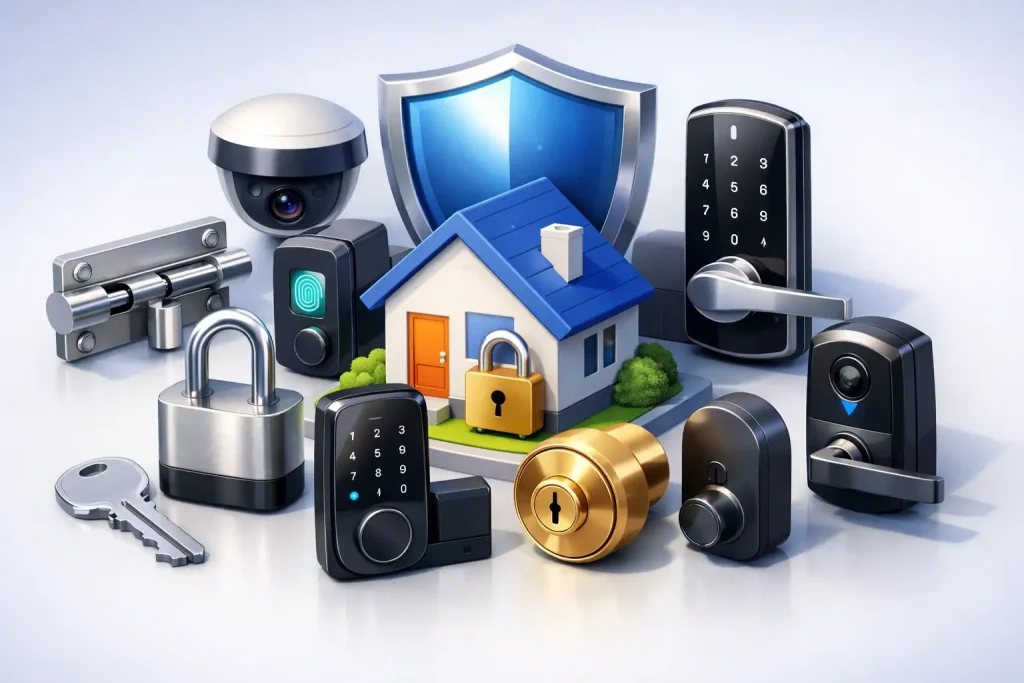
A front door can look solid and still be the weak point of the house. We see it often – a decent door fitted with a basic cylinder, a tired night latch, or a multipoint lock that no longer lines up properly. If you are comparing the best locks for home security, the right answer is rarely one single lock. It depends on your door, your frame, how the property is used, and whether the lock is installed and aligned properly.
For most households, better security comes from choosing the correct lock for the door you already have, not from buying the most expensive product on the shelf. A good lock on a poorly adjusted door will still let you down. Equally, a well-fitted standard lock can outperform a premium one that is loose, worn, or fitted to the wrong type of door.
What makes the best locks for home security?
The best locks do two jobs. First, they resist common attack methods such as snapping, drilling, bumping and forced entry. Second, they work reliably every day without sticking, dropping or needing a particular knack to lock.
That matters because home security is not only about burglary resistance. It is also about whether you actually use the lock properly. If a lock is awkward, many people stop double-locking it, leave the key in the wrong place, or put off fixing a fault until the mechanism fails completely.
When choosing, focus on four things: the door type, the lock standard, how the frame and hardware work together, and who needs access. A family home, a rented flat, and a short-let property may all need slightly different solutions.
Best locks for home security by door type
Euro cylinder locks for uPVC and composite doors
For uPVC and composite doors, the euro cylinder is often the part that matters most. Many break-ins on these doors target the cylinder rather than the full multipoint mechanism. An anti-snap, anti-drill, anti-pick cylinder is usually the most worthwhile upgrade.
If your door has a handle set and lifts to engage locking points, the centre cylinder is the part most likely to be attacked. A basic cylinder can often be overcome quickly. A high-security replacement cylinder is a much better option, especially if the current one protrudes beyond the handle or has no visible attack protection.
This is one of the most cost-effective upgrades for many homes in Scotland. It can also make a real difference for landlords and hosts, where key control and changeovers matter.
Mortice sashlocks and deadlocks for timber doors
Timber front and back doors are often best secured with a mortice lock. A 5-lever mortice sashlock is common for main entry doors because it combines a latch and a deadbolt in one body. A mortice deadlock, used alongside a separate latch or handle set, is also a strong choice.
The key point here is that the lock body is only part of the picture. The strength of the keep, the length of the screws, and the condition of the timber around the frame all matter. A good mortice lock fitted into tired wood with a weak strike plate is not giving you the protection you think it is.
Night latches for controlled entry
Night latches can be useful, but they are rarely the whole answer for external security. On a solid timber door, a good quality night latch can add convenience and controlled access, especially when paired with a mortice deadlock.
Used on its own, a night latch is usually not the best option for a main entrance. It is more vulnerable than a well-fitted deadlock, and some older models are not especially resistant to force. Where a door relies only on a latch, there is often room for improvement.
Multipoint locking systems
Multipoint locks are common on modern doors and can be very effective, but they are often misunderstood. People assume that more locking points automatically means better security. Sometimes that is true, but only if the mechanism is in good condition and the door is correctly aligned.
A misaligned multipoint lock can become difficult to lift and lock. That leads to extra force on the handle, wear in the gearbox, and eventually a door that either will not secure properly or will not open at all. In those cases, the fix may be
door realignment, hinge adjustment, or replacing worn parts rather than upgrading the whole system.
Standards matter, but they are not the whole story
You will often see lock grades and security standards mentioned in product descriptions. They matter because they show that a lock has been tested against certain attack methods or performance requirements. But testing is not the same as real-world protection if the lock is poorly fitted or used on the wrong door.
For example, a high-spec cylinder on a loose handle with exposed fixings may still leave avoidable weaknesses. A quality mortice lock fitted without reinforcing the frame may not perform as intended under force. The best result usually comes from looking at the full entry point rather than buying by badge alone.
That is also why honest advice matters. Not every home needs every possible upgrade. Sometimes a new cylinder and a proper adjustment are enough. In other cases, the right answer is replacing old hardware, improving the keeps, or sorting a door that has dropped.
Smart locks: useful for some homes, not ideal for all
Smart locks get a lot of attention, and for some households they are genuinely useful. They can suit short-let properties, busy families, or landlords managing access without constant key handovers. Audit trails, timed codes and app control can be practical benefits.
That said, smart locks are not automatically the best locks for home security. It depends on the product, the door, and how the household uses it. Battery reliance, connectivity issues, user error and poor fitting can all create problems. Some smart models also compromise on physical strength compared with a more traditional high-security setup.
If you are considering one, think about how it fails. Can you still get in if batteries die? Is there a physical override? Does it work properly with your existing multipoint system? Convenience is useful, but the basic physical security still has to be right.
Common weak points people miss
A lock upgrade helps, but there are a few weak spots that often get overlooked.
Door alignment is a big one. If a door catches, needs to be lifted, or only locks with a shove, the problem may be the alignment rather than the lock itself. Left alone, that sort of fault usually gets worse.
Cylinder size is another. On uPVC and composite doors, an overlong cylinder that sticks out past the handle can be far easier to attack. The replacement needs to be not only secure, but correctly sized.
Then there is key control. If you have moved in recently,
lost a key, had trades through the house, or run a holiday let, replacing or reconfiguring locks can be more sensible than hoping every copy has been accounted for.
How to choose the right lock for your property
Start with the door you actually have, not the lock you have seen advertised. Timber, uPVC, composite and glazed doors all have different strengths, weaknesses and hardware requirements.
Then think about how the property is used. A homeowner may want strong everyday security with simple operation. A landlord may need reliable locks that are easy to manage between tenancies. An
HMO or short-let property may need a balance between secure access, fire safety, and practical key control.
After that, be realistic about the problem you are trying to solve. If the concern is forced entry, the answer may be a better cylinder or deadlock. If the problem is a stiff handle or door that will not lock cleanly, replacing parts without correcting the alignment may waste money.
In practice, the best setup is often a combination of sensible upgrades rather than one dramatic change. A secure cylinder, a correctly adjusted door, solid keeps, and dependable
installation will usually do more for household security than chasing the latest gadget.
When it is worth getting advice
Locks are one of those jobs where the details matter. Two doors can look similar but take different hardware. A lock that is excellent on one entrance can be unsuitable on another. And if a door is already under strain, changing the lock alone may not cure the fault.
That is where straightforward advice is useful. A good locksmith should explain what needs changed, what can stay, and what is likely to be causing the issue. You should also know the cost before anyone sets off, not after the work is done. That level of clarity matters most when you are dealing with security at home.
For central Scotland households, Scotia Locksmiths sees the same pattern again and again: people put up with awkward locks for months, then end up needing urgent help when the mechanism finally fails. Sorting weak cylinders, sticking doors and worn hardware early is usually cheaper and less stressful than waiting for a lockout or a break-in.
If you are weighing up the best locks for home security, think less about hype and more about fit, condition and day-to-day reliability. The right lock is the one that suits your door, resists common attacks, and works properly every time you turn the key.
Scotia Locksmiths are trusted, local, mobile locksmiths serving the following areas:
Perthshire & Kinross: Perth,
Crieff,
Blairgowrie,
Kinross,
Pitlochry,
Aberfeldy
Stirlingshire: Stirling,
Dunblane,
Callander,
Killin,
Lochearnhead
Dundee & Angus: Dundee,
Broughty Ferry,
Monifieth,
Carnoustie
Fife: Dunfermline,
Kirkcaldy,
Glenrothes,
St Andrews,
Cupar,
Leven,
Rosyth
West Lothian and Falkirk: Falkirk,
Grangemouth,
Livingston,
Bathgate
Lanarkshire: Cumbernauld,
Airdrie,
Bellshill,
Motherwell,
Hamilton,
Cambuslang
Clackmannanshire: Alloa,
Tillicoultry,
Tullibody,
Alva,
Dollar.